
 By Olivia Wilson Media Team
You published a new blog post last week. You spent hours writing it, editing it, and making sure it looked perfect on your website. But when you search for the topic on Google, your page is nowhere to be found. A competitor’s article ranks on page one, and their content is not even as detailed as yours.
This is one of the most frustrating experiences in digital marketing. And the reason it happens is usually simple. Your competitor optimized their page for search engines. You did not.
Great content is only half the battle. The other half is making sure search engines understand what your page is about and why it deserves to rank. That is exactly what on-page SEO techniques help you do.
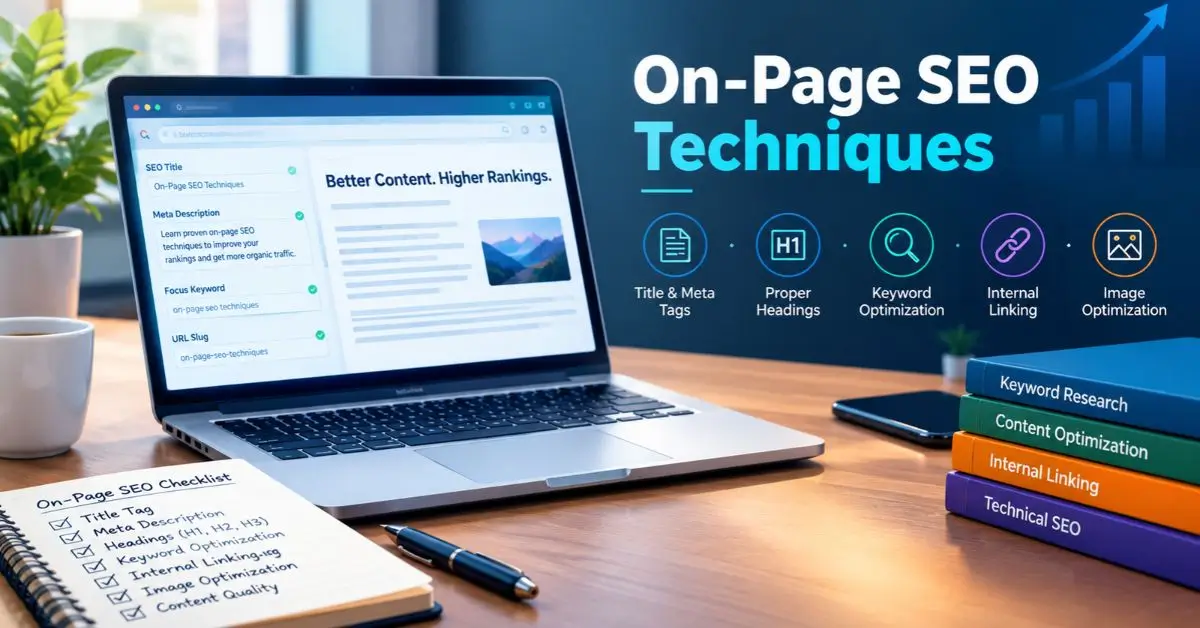
On-page SEO techniques are specific actions you take directly on your web pages to help search engines understand, index, and rank your content higher. These include optimizing title tags, meta descriptions, headings, content structure, internal links, images, and URL formats to match what users are searching for.
On-page SEO is about making each page on your website as clear and relevant as possible for both search engines and human readers. The most effective on-page SEO techniques include writing optimized title tags, matching content to search intent, structuring headings properly, adding internal links, and improving page speed. When applied consistently, these techniques lead to higher rankings and more organic traffic.
Some people claim that on-page SEO is dead. They say Google is so smart now that it can figure out your content without any optimization. That is not true.
Google has gotten better at understanding natural language, yes. But it still relies on clear signals from your page to determine relevance. If your title tag says “Home” and your competitor’s title tag says “Best Plumbing Services in Austin, TX,” Google knows exactly which page to show when someone searches for a plumber in Austin.
On-page optimization is also the one area of SEO that you have complete control over. You cannot force other websites to link to you. You cannot control Google’s algorithm updates. But you can control every word, tag, and image on your own pages.
A real example: a small accounting firm in Portland updated the title tags, meta descriptions, and heading structures on their 15 service pages. They did not create any new content or build any new backlinks. Within six weeks, their organic traffic increased by 35% simply because Google could finally understand what each page was about.
That is the power of getting the fundamentals right.
Not all optimization tactics carry equal weight. Here are the techniques that consistently deliver the biggest impact based on real-world results.
Your title tag is the single most important on-page ranking factor. It is the blue clickable headline that appears in Google search results, and it tells both users and search engines what your page is about.
Every title tag should include your primary keyword near the beginning. Keep it under 60 characters so it does not get cut off in search results. And make it compelling enough that people actually want to click on it.
Bad example: “Services | Smith & Co.”
Good example: “Tax Preparation Services in Portland, OR | Smith & Co.”
The second version tells Google exactly what the page offers and where. It also gives the searcher a clear reason to click.
Meta descriptions do not directly affect rankings, but they heavily influence your click-through rate. A higher click-through rate sends positive signals to Google, which can indirectly boost your position over time.
Write your meta description like a short advertisement. Include your primary keyword naturally, add a clear benefit, and keep it between 150 and 160 characters. Give the reader a reason to choose your result over the others on the page.
This is the technique that separates pages that rank from pages that do not. Search intent is the reason behind a user’s query. Google wants to show results that satisfy that reason.
There are four main types of search intent:
- Informational: The user wants to learn something (“what is a Roth IRA”)
- Commercial: The user is comparing options (“best accounting software 2025”)
- Transactional: The user is ready to buy or hire (“hire tax accountant Portland”)
- Navigational: The user wants a specific website (“QuickBooks login”)
If someone searches “what is a Roth IRA” and your page is a sales pitch for your financial advisory services, Google will not rank you. The user wants information, not a sales page. Study the top five results for your target keyword and match the content type and format they use.
Heading tags (H1, H2, H3) create a hierarchy that helps both readers and search engines understand your content structure.
Your H1 should be the main title of the page and include your primary keyword. Use H2 tags for major sections and H3 tags for subtopics within those sections. Do not skip heading levels. Going from H1 directly to H3 confuses the structure.
More importantly, use headings to break up your content into scannable chunks. Most readers skim before they read. Clear headings help them find the information they need quickly, which reduces bounce rates and increases time on page.
Clean, descriptive URLs help search engines and users understand what a page is about before they even click on it.
Bad URL: “yoursite.com/p=12345”
Good URL: “yoursite.com/tax-preparation-services-portland”
Keep URLs short, include your primary keyword, and use hyphens to separate words. Avoid using dates, numbers, or random strings of characters unless absolutely necessary.
Internal links connect your pages to each other. They help Google discover new content, understand the relationship between your pages, and distribute authority throughout your site.
Every important page on your website should have at least three to five internal links pointing to it from other relevant pages. Use descriptive anchor text that tells the reader (and Google) what the linked page is about.
For example, instead of linking with the word “here,” use anchor text like “learn more about our keyword research process.” This gives Google clear context about the destination page. If you want to dive deeper into the technical side of site optimization, our guide on technical SEO services covers the infrastructure work that supports your on-page efforts.
Search engines cannot see images the way humans can. They rely on file names and alt text to understand what an image shows.
Before uploading any image, rename the file to something descriptive. Instead of “IMG_4523.jpg,” use “portland-tax-accountant-office.jpg.” Then add alt text that describes the image naturally while including a relevant keyword when appropriate.
Also compress your images before uploading. Large image files slow down your page, and page speed is a confirmed ranking factor. Tools like TinyPNG or ShortPixel can reduce file sizes by 50% or more without noticeable quality loss.
Page speed affects both rankings and user experience. Google’s Core Web Vitals metrics measure how fast your page loads, how quickly it becomes interactive, and how stable the layout stays during loading.
The most impactful speed improvements come from compressing images, enabling browser caching, removing unused plugins, and using a reliable hosting provider. Aim for a load time under 2.5 seconds on mobile devices.
Gone are the days when you needed to repeat your exact keyword 20 times on a page. Google now understands context and synonyms. Instead of forcing your primary keyword into every paragraph, use related terms and natural variations throughout your content.
If your target keyword is “tax preparation services,” related terms might include “tax filing,” “tax return help,” “CPA services,” “income tax assistance,” and “tax planning.” Using these naturally throughout your content helps Google understand the full scope of your page.
Even experienced marketers make these errors. Watch out for them.
Keyword stuffing. Repeating your target keyword unnaturally makes your content unreadable and can trigger spam filters. Use your primary keyword two to three times and fill the rest with semantic variations.
Duplicate title tags. Every page on your site needs a unique title tag. If multiple pages share the same title, Google will not know which one to rank for a given query.
Thin content. Pages with less than 300 words rarely rank for competitive terms. Aim for comprehensive coverage of your topic. The right length depends on the query, but most ranking pages have at least 1,000 words of useful content.
Ignoring mobile experience. Over 60% of searches happen on mobile devices. If your content is hard to read on a phone, your rankings will suffer regardless of how well you optimize your title tags.
Here is a simple table to help you decide which on-page SEO techniques to tackle first based on impact and effort.
| Technique | Impact on Rankings | Effort Level | Do This First? |
|---|---|---|---|
| Optimize title tags | Very High | Low | Yes |
| Match content to search intent | Very High | Medium | Yes |
| Fix heading structure | High | Low | Yes |
| Add internal links | High | Low | Yes |
| Write meta descriptions | Medium | Low | After titles |
| Compress images | Medium | Low | After titles |
| Improve page speed | High | Medium | Within first month |
| Add semantic keywords | Medium | Medium | Ongoing |
Start with the high-impact, low-effort items. They deliver the fastest results and build momentum for the bigger projects.
Mastering on-page SEO techniques is one of the smartest investments you can make for your website. Unlike backlink building or paid advertising, on-page optimization is completely within your control. You can start today, and you do not need a big budget to see results.
The key is consistency. Optimizing one page will not transform your traffic. But optimizing every important page on your site, one by one, creates a compounding effect that builds over months and years.
Start with your highest-traffic pages. Fix the title tags, align the content with search intent, clean up the headings, and add strategic internal links. Then move to the next page. Repeat the process. The results will follow.
The key on-page SEO techniques are optimizing title tags, matching search intent, using clear headings, and writing helpful content. These practices help search engines understand your page.
Review your on-page SEO every six to twelve months or when rankings, search intent, or information changes. Update content when needed to keep it accurate and useful.
Yes, on-page SEO can help pages rank on Google’s first page for low-competition keywords. Competitive keywords may also require relevant backlinks, strong content, and overall site authority.
There is no fixed ideal keyword density for on-page SEO. Use your target keyword naturally and focus on readability, search intent, and relevant terms instead of keyword repetition.
On-page SEO changes may take days or weeks to be reflected in Google’s index and rankings. The timeline varies depending on crawling, competition, and the type of changes made.